Salary Calculator - Convert Your Wage Rate Across All Pay Periods

Salary Calculator

($) per

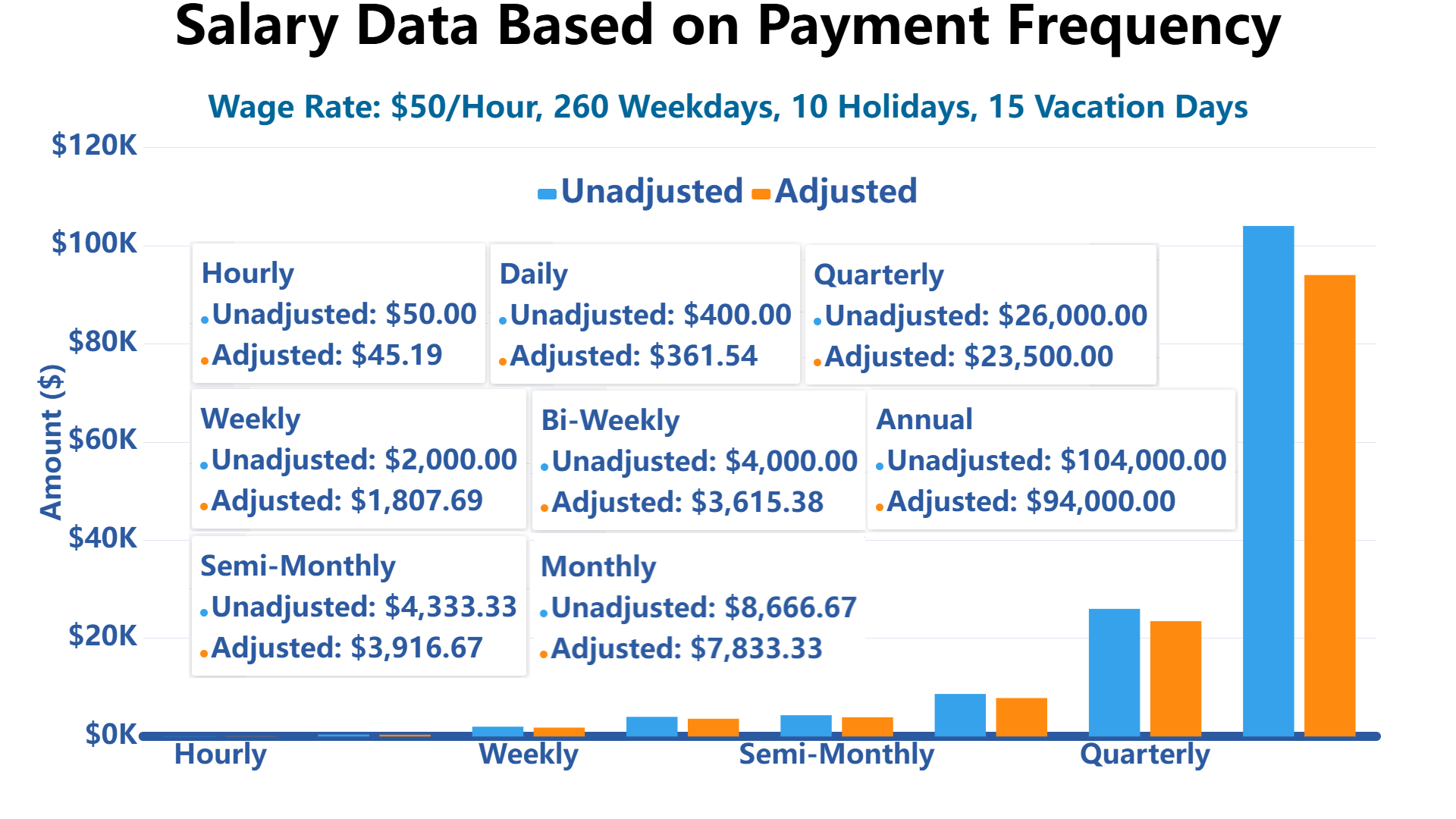
Calculation Results

DurationRaw AmountAdjusted for Paid Leave
Hourly
Daily
Weekly
Bi-Weekly
Semi-Monthly
Monthly
Quarterly
Annual

This tool is designed to help employees, freelancers, and employers understand compensation structures and make informed decisions about job offers, salary negotiations, and budgeting.

Monthly Salary Breakdown & Salary Comparison Across Pay Periods

Hourly Rate Reference Table

HourlyDailyWeeklyBi-WeeklySemi-MonthlyMonthlyQuarterlyAnnual

Industry Standards and Benchmarks

Standard Work Hours by Country

CountryStandard Weekly HoursAnnual Working DaysTypical Paid HolidaysMinimum Vacation Days
United States40 hours260 days10 days (average)0 (no federal requirement)
United Kingdom37.5-40 hours252 days8 days28 days (including holidays)
Canada40 hours260 days9-10 days10 days (varies by province)
Australia38 hours260 days11 days20 days
Germany40 hours260 days9-13 days (varies by state)20 days (minimum)
France35 hours218 days11 days25 days

U.S. Paid Time Off Averages by Industry

IndustryAverage Paid HolidaysAverage Vacation Days (1-5 years)Average Vacation Days (10+ years)
Technology10-12 days15-20 days20-25 days
Finance/Banking10-11 days10-15 days15-20 days
Healthcare8-10 days10-15 days15-20 days
Manufacturing8-10 days10-12 days15-18 days
Retail6-8 days5-10 days10-15 days
Government (Federal)11 days13 days26 days

Pay Period Preferences by Industry

Different industries tend to favor specific pay period structures:

  • Bi-Weekly (Most Common): Used by approximately 43% of U.S. employers. Popular in healthcare, manufacturing, and retail sectors.
  • Semi-Monthly: Used by about 19% of employers. Common in professional services, finance, and corporate environments.
  • Weekly: Used by about 33% of employers. Common in construction, hospitality, and temporary staffing.
  • Monthly: Used by about 5% of employers. Common in education and some government positions.

Detailed Calculation Formulas

1. Basic Hourly to Annual Conversion

Formula:

Annual Salary = Hourly Rate × Hours per Week × Weeks per Year
Annual Salary = Hourly Rate × Hours per Week × 52
Example:

If you earn $25/hour and work 40 hours per week:

Annual Salary = $25 × 40 × 52 = $52,000

2. Annual to Hourly Conversion

Formula:

Hourly Rate = Annual Salary ÷ (Hours per Week × Weeks per Year)
Hourly Rate = Annual Salary ÷ 2,080 (for standard 40-hour work week)
Example:

If your annual salary is $60,000:

Hourly Rate = $60,000 ÷ 2,080 = $28.85/hour

3. Daily Rate Calculation

Formula:

Daily Rate = Hourly Rate × Hours per Day
Or: Daily Rate = Annual Salary ÷ Working Days per Year
Example:

With $25/hour and 8-hour workdays:

Daily Rate = $25 × 8 = $200/day

Or with $52,000 annual salary and 260 working days:

Daily Rate = $52,000 ÷ 260 = $200/day

4. Weekly Salary Calculation

Formula:

Weekly Salary = Hourly Rate × Hours per Week
Or: Weekly Salary = Annual Salary ÷ 52
Example:

With $25/hour and 40-hour work week:

Weekly Salary = $25 × 40 = $1,000/week

5. Bi-Weekly Pay Calculation

Formula:

Bi-Weekly Pay = Weekly Salary × 2
Or: Bi-Weekly Pay = Annual Salary ÷ 26
Note: There are 26 bi-weekly pay periods in a year (52 weeks ÷ 2)
Example:

With $52,000 annual salary:

Bi-Weekly Pay = $52,000 ÷ 26 = $2,000 per pay period

6. Semi-Monthly Pay Calculation

Formula:

Semi-Monthly Pay = Annual Salary ÷ 24
Note: Semi-monthly means twice per month (24 pay periods per year)
This differs from bi-weekly, which has 26 pay periods
Example:

With $52,000 annual salary:

Semi-Monthly Pay = $52,000 ÷ 24 = $2,166.67 per pay period

Important: Semi-monthly pay ($2,166.67) is higher than bi-weekly pay ($2,000) because there are fewer pay periods.

7. Monthly Salary Calculation

Formula:

Monthly Salary = Annual Salary ÷ 12
Or: Monthly Salary = Hourly Rate × Hours per Week × 52 ÷ 12
Example:

With $52,000 annual salary:

Monthly Salary = $52,000 ÷ 12 = $4,333.33/month

8. Quarterly Salary Calculation

Formula:

Quarterly Salary = Annual Salary ÷ 4
Or: Quarterly Salary = Monthly Salary × 3
Example:

With $52,000 annual salary:

Quarterly Salary = $52,000 ÷ 4 = $13,000 per quarter

Adjusted Salary Calculations (Including Paid Time Off)

9. Effective Hourly Rate with Paid Time Off

Formula:

Actual Working Days = Total Working Days - Paid Holidays - Vacation Days
Actual Working Hours = Actual Working Days × Hours per Day
Adjusted Hourly Rate = Annual Salary ÷ Actual Working Hours
Example:

With $52,000 annual salary, 260 working days, 10 holidays, 15 vacation days, and 8-hour days:

Actual Working Days = 260 - 10 - 15 = 235 days

Actual Working Hours = 235 × 8 = 1,880 hours

Adjusted Hourly Rate = $52,000 ÷ 1,880 = $27.66/hour

Note: The adjusted rate ($27.66) is higher than the raw rate ($25.00) because you're paid for days you don't work.

10. Paid Time Off Impact

Formula:

PTO Percentage = (Paid Holidays + Vacation Days) ÷ Total Working Days × 100%
Hourly Rate Increase = Raw Hourly Rate × (1 + PTO Percentage)
Example:

With 25 total PTO days and 260 working days:

PTO Percentage = 25 ÷ 260 = 9.62%

If Raw Hourly Rate = $25.00

Adjusted Rate = $25.00 × 1.0962 = $27.41/hour

How to Use This Salary Calculator

Step-by-Step Instructions

Step 1: Enter Your Base Wage Information

Start by entering your current wage rate in the "Wage Rate" field. You can input this in any pay period format:

  • Hourly: Your per-hour rate (e.g., $25.00/hour)
  • Daily: Your per-day rate (e.g., $200/day)
  • Weekly: Your per-week rate (e.g., $1,000/week)
  • Bi-Weekly: Your every-two-weeks rate (e.g., $2,000/bi-week)
  • Semi-Monthly: Your twice-per-month rate (e.g., $2,166.67/semi-month)
  • Monthly: Your per-month rate (e.g., $4,333.33/month)
  • Quarterly: Your per-quarter rate (e.g., $13,000/quarter)
  • Annual: Your per-year rate (e.g., $52,000/year)

Step 2: Configure Your Work Schedule

Adjust the following fields to match your actual employment terms:

Working Days Per Week: Typically 5 for full-time employees (Monday-Friday), but may be 4, 6, or 7 depending on your schedule. Part-time workers should enter their actual working days.

Weekly Working Hours: Standard is 40 hours for full-time employment in the U.S. (as defined by the Fair Labor Standards Act). Part-time positions typically range from 20-35 hours. Some industries work 37.5 or 35-hour weeks.

Annual Working Weeks: Default is 52 weeks. Adjust if you have unpaid time off or seasonal employment. For example, teachers might work 36-40 weeks per year.

Daily Working Hours: Typically 8 hours for full-time employees. This should equal Weekly Working Hours ÷ Working Days Per Week.

Annual Working Days: Standard is 260 days (52 weeks × 5 days). This represents the maximum working days before accounting for holidays and vacation.

Step 3: Add Paid Time Off Information

Include your benefits to see adjusted salary calculations:

Paid Holidays Annually: Enter the number of paid holidays your employer provides. According to the U.S. Bureau of Labor Statistics, the average is 8-10 days. Federal holidays total 11 days, but private sector averages vary.

Annual Leave Days: Enter your paid vacation days. The U.S. average is 10-15 days for employees with 1-5 years of service, increasing to 15-20 days with more tenure. This doesn't include sick leave.

Step 4: Calculate and Interpret Results

Click the "Calculate" button to generate your comprehensive salary breakdown. The results table shows:

  • Raw Amount: Your earnings based purely on working hours without considering paid time off
  • Adjusted for Paid Leave: Your effective earnings when factoring in that you're paid for holidays and vacation days you don't work

Understanding the Difference Between Pay Periods

Bi-Weekly vs. Semi-Monthly: What's the Difference?

This is one of the most commonly confused aspects of salary calculations:

AspectBi-WeeklySemi-Monthly
Pay Periods per Year26 pay periods24 pay periods
Payment ScheduleEvery two weeks (e.g., every other Friday)Twice per month (e.g.,15th and last day of month)
CalculationAnnual Salary ÷ 26Annual Salary ÷ 24
Paycheck AmountSmaller (more frequent)Larger (less frequent)
Example ($52,000/year)$2,000 per paycheck$2,166.67 per paycheck
Months with 3 Paychecks2 months per yearNever

Important Note: With bi-weekly pay, you receive 26 paychecks per year, which means two months will have three paychecks instead of two. This can be helpful for budgeting extra expenses or savings.

Common Calculation Scenarios

Scenario 1: Comparing Job Offers

When comparing job offers with different pay structures:

Job A: $28/hour, 40 hours/week, 10 holidays, 15 vacation days

Job B: $55,000/year salary, 8 holidays, 10 vacation days

Use the calculator to convert both to the same pay period (e.g., annual) and compare the adjusted amounts that account for paid time off. Job A = $58,240/year, Job B = $55,000/year. Job A offers better compensation.

Scenario 2: Negotiating a Raise

Understanding your hourly equivalent helps in salary negotiations:

If you currently earn $50,000/year and want a10% raise:

New Salary = $50,000 × 1.10 = $55,000/year

This equals $26.44/hour (from $24.04/hour)

Monthly increase = $416.67

Scenario 3: Freelance Rate Setting

Freelancers need to account for unbilled time and lack of benefits:

If you want to match a $60,000 salaried position:

Base hourly equivalent = $28.85/hour

Freelance rate should be 1.5-2× higher = $43-58/hour

This accounts for self-employment taxes, health insurance, unbilled administrative time, and lack of paid time off.

References

This salary calculator and the information provided are based on established labor standards, government regulations, and authoritative sources:

U.S. Government Sources

  • U.S. Department of Labor - Fair Labor Standards Act (FLSA)

    www.dol.gov/agencies/whd/flsa

    Establishes minimum wage, overtime pay, recordkeeping, and youth employment standards. Defines the standard 40-hour work week and overtime requirements.

  • U.S. Bureau of Labor Statistics (BLS)

    www.bls.gov

    Provides comprehensive data on employment, wages, benefits, and working conditions across industries and occupations.

  • Internal Revenue Service (IRS)

    www.irs.gov

    Tax information, withholding guidelines, and employment tax regulations.

  • Social Security Administration

    www.ssa.gov

    FICA tax rates, wage base limits, and benefit calculations.

Professional and Industry Organizations

  • Society for Human Resource Management (SHRM)

    www.shrm.org

    HR best practices, compensation surveys, and benefits benchmarking data.

  • American Payroll Association (APA)

    www.americanpayroll.org

    Payroll processing standards, compliance guidelines, and pay period best practices.

  • WorldatWork

    www.worldatwork.org

    Total rewards, compensation, and benefits research and education.

Calculation Standards

  • Standard Work Year: 2,080 hours (40 hours/week × 52 weeks) - Widely accepted standard in U.S. employment and compensation calculations
  • Working Days per Year: 260 days (52 weeks × 5 days) - Standard for full-time Monday-Friday schedules
  • Pay Period Calculations: Based on standard accounting practices and payroll industry standards
  • Bi-Weekly Periods: 26 per year (52 weeks ÷ 2)
  • Semi-Monthly Periods: 24 per year (12 months × 2)

FAQ

Q: Why Is My Adjusted Hourly Rate Higher Than My Raw Hourly Rate?

A: The adjusted hourly rate accounts for paid time off (holidays and vacation days). Since you're paid for days you don't work, your effective hourly rate for actual working hours is higher. For example, if you earn $50,000/year and work 1,880 hours instead of 2,080 hours (due to 25 days of PTO), your adjusted rate is $26.60/hour instead of $24.04/hour.

Q: What's the Difference Between Bi-weekly and Semi-monthly Pay?

A: Bi-weekly means every two weeks (26 pay periods per year), while semi-monthly means twice per month (24 pay periods per year). Bi-weekly paychecks are smaller but more frequent. With bi-weekly pay, you'll receive three paychecks in two months each year.

Q: Should I Use the Raw or Adjusted Salary When Comparing Job Offers?

A: Use the adjusted salary for accurate comparisons, as it reflects the true value of your compensation including paid time off. A job with lower base pay but more PTO might actually offer better total compensation.

Q: How Do I Calculate My Hourly Rate if I'm Salaried?

A: Divide your annual salary by 2,080 (the standard number of working hours in a year for a40-hour work week). For example, $60,000 ÷ 2,080 = $28.85/hour.

Q: Does This Calculator Account for Taxes?

A: No, this calculator shows gross income before taxes and deductions. Your actual take-home pay will be 70-80% of the calculated amount, depending on your tax bracket, state, and deductions.

Q: What if I Work Part-time or Irregular Hours?

A: Adjust the "Weekly Working Hours" and "Working Days Per Week" fields to match your actual schedule. For example, if you work 25 hours per week over 3 days, enter those values for accurate calculations.

Q: How Do I Factor in Overtime Pay?

A: This calculator is designed for standard salary calculations. For overtime, calculate separately: overtime hours × (hourly rate × 1.5) and add to your base pay.

Q: What About Bonuses and Commissions?

A: This calculator focuses on base salary. To include bonuses, add your expected annual bonus to your annual salary before converting to other pay periods. For commission-based roles, use your base salary plus average annual commission.

Q: Why Do the Reference Tables Use 8-hour Days and 40-hour Weeks?

A: These are the standard full-time work parameters in the United States as defined by the Fair Labor Standards Act. You can adjust these values in the calculator for your specific situation.

Q: How Accurate Are These Calculations?

A: The calculations are mathematically precise based on the inputs you provide. However, actual paychecks may vary slightly due to rounding, pay period timing, and employer-specific payroll practices.

Q: Can I Use This for International Salary Calculations?

A: Yes, but adjust the working hours, days, and weeks to match your country's standards. For example, France has a 35-hour standard work week, while Australia uses 38 hours.

Q: What if My Employer Offers Unlimited

A: For unlimited PTO policies, estimate the average number of days you realistically expect to take (typically 15-20 days) and enter that value. Studies show employees with unlimited PTO often take similar or fewer days than those with set allocations.

Write Reply

Leave a Reply

Your email address will not be published. Required fields are marked *

^