BMI Calculator
Estimate Body Mass Index From Height and Weight.It Supports Both Metric Units and Us Units, and It Also Shows BMI Prime,Ponderal Index, and Healthy Weight Ranges for Your Height.
BMI Calculator
Calculation Results
| BMI Category & Range (kg/m²) | Weight Range (kg) | |
|---|---|---|
| Underweight (< 18.5) | Severe Thinness (< 16) | |
| Moderate Thinness (16 - 17) | ||
| Mild Thinness (17 - 18.5) | ||
| Healthy (18.5 – 25) | ||
| Overweight (25 – 30) | ||
| Obesity (> 30) | Obese Class I (30 - 35) | |
| Obese Class II (35 - 40) | ||
| Obese Class III (> 40) | ||
How to Use the BMI Calculator
Choose either Metric Units or US Units, enter your height and weight, then click Calculate. The calculator estimates your BMI, BMI category, healthy weight range, BMI Prime, and Ponderal Index.
For most adults, BMI is a useful first screening number. However, it should be interpreted alongside waist circumference, body fat percentage, muscle mass, age, ethnicity, medical history, and lifestyle.
What Your BMI Result Means
BMI places your height and weight into a general category. A result in the healthy range may suggest lower weight-related health risk, while a result in the underweight, overweight, or obesity range may indicate that additional health checks are worthwhile.
| BMI Result | General Meaning | Suggested Next Step |
|---|---|---|
| Below 18.5 | Underweight range | Review nutrition, recent weight changes, and possible medical causes with a healthcare professional. |
| 18.5 - 24.9 | Healthy range for many adults | Maintain regular activity, balanced nutrition, sleep quality, and waist measurement tracking. |
| 25 - 29.9 | Overweight range | Check waist circumference, blood pressure, blood glucose, cholesterol, and body fat percentage. |
| 30 or higher | Obesity range | Consider a structured plan with a clinician, registered dietitian, or qualified fitness professional. |
Expert Insights: What to Do After You Get Your BMI
A BMI number is most useful when it leads to a practical next step. Use the guidance below as general education, not as a personal medical diagnosis.
If Your BMI Is Near a Category Border
If your BMI is close to 18.5, 25, or 30, avoid overreacting to a single number. Small changes in hydration, clothing, measurement error, or time of day can shift the result slightly.
Action step: measure your waist circumference, review your weight trend over the past 3 to 6 months, and consider checking body fat percentage using a reliable method such as DEXA, Bod Pod, skinfold testing by a trained professional, or a high-quality bioelectrical impedance scale.
If You Are Active or Muscular
BMI may classify muscular people as overweight even when their body fat level is healthy. Strength athletes, sprinters, rugby players, military personnel, and fitness competitors often have higher body weight because of lean mass.
Action step: compare BMI with waist-to-height ratio, body fat percentage, resting heart rate, blood pressure, blood lipids, and performance markers.
If Your BMI Is High and Waist Size Is Also High
A high BMI combined with a high waist circumference may suggest higher cardiometabolic risk than BMI alone. This is especially relevant when accompanied by elevated blood pressure, high triglycerides, low HDL cholesterol, insulin resistance, or a family history of type 2 diabetes.
Action step: discuss a complete risk assessment with a healthcare professional. A modest and sustainable weight reduction may improve several risk markers for many people.
BMI Formula
Body Mass Index is calculated from your weight and height:
Metric units:
BMI = weight (kg) / [height (m)]²
US units:
BMI = 703 × weight (lb) / [height (in)]²
BMI Prime: A Simpler Way to Read BMI
BMI Prime compares your BMI with 25, which is commonly used as the upper limit of the standard healthy BMI range for many adults.
BMI Prime = BMI / 25
A BMI Prime of 1.0 means your BMI is exactly 25. A value below 1.0 means your BMI is below 25, while a value above 1.0 means your BMI is above 25.
This can be useful because it turns BMI into a quick ratio. For example, a BMI Prime of 1.20 means your BMI is about 20% above the standard upper healthy cutoff.
Ponderal Index: Why It Can Add Context
The Ponderal Index compares body weight with height cubed rather than height squared:
Ponderal Index = weight (kg) / [height (m)]³
BMI uses height squared, which works reasonably well for many adults but can be less accurate for people who are unusually tall or short. The Ponderal Index may sometimes give a more proportional view of body mass across different heights because it scales weight against height cubed.
In practical terms, Ponderal Index can be helpful when two people have the same BMI but very different heights, or when evaluating whether BMI may be overestimating or underestimating body size due to stature.
Case Study: Same Weight, Different Body Composition
Two adults can have the same height, weight, and BMI but very different health and fitness profiles. This is one of the most important limitations of BMI.
| Person | Height and Weight | BMI | Estimated Body Fat | Interpretation |
|---|---|---|---|---|
| Person A: Strength-trained adult | 5 ft 10 in, 180 lb | 25.8 | Approximately 14% | BMI says overweight, but high lean mass may explain the higher weight. |
| Person B: Sedentary adult | 5 ft 10 in, 180 lb | 25.8 | Approximately 30% | Same BMI, but higher body fat may indicate greater metabolic risk. |
The key lesson is that BMI measures weight relative to height, not fat mass. For a more complete picture, combine BMI with body fat percentage, waist circumference, blood pressure, lab markers, physical activity level, and medical history.
BMI and Life Insurance Premiums
For users comparing financial products, BMI can matter beyond general health. In many life insurance underwriting processes, height and weight are used as part of the risk assessment. Applicants with BMI values in a preferred range may be more likely to qualify for better rate classes, while very high or very low BMI values can sometimes lead to higher premiums or additional medical review.
Insurers do not usually price policies from BMI alone. They may also consider age, sex, smoking status, blood pressure, cholesterol, diabetes history, prescription medications, family medical history, driving record, occupation, hobbies, and the results of a medical exam.
| BMI Situation | Possible Insurance Impact | Practical Tip |
|---|---|---|
| Healthy BMI and strong health markers | May support preferred or better rate classes | Compare quotes from multiple insurers, as underwriting rules vary. |
| Borderline overweight BMI | May still qualify for competitive rates if other markers are strong | Waist size, blood pressure, and lab results may help provide context. |
| High BMI with other risk factors | May lead to higher premiums or additional underwriting questions | Improving blood pressure, glucose, cholesterol, and weight trend may help future applications. |
| Very low BMI | May trigger review if linked to medical concerns or unexplained weight loss | Be prepared to explain stable weight history and relevant medical information. |
Important: Insurance underwriting standards differ by company and country. A BMI that affects pricing with one insurer may be treated differently by another insurer.
Example 1: Metric Units
Example:
Height = 185 cm = 1.85 m
Weight = 65 kg
BMI = 65 / (1.85 × 1.85) = 18.99
BMI Prime = 18.99 / 25 = 0.76
Ponderal Index = 65 / (1.85 × 1.85 × 1.85) = 10.26 kg/m³
This result is within the healthy BMI range, but it is close to the lower boundary. If this person has recently lost weight unintentionally, feels fatigued, or has appetite changes, BMI alone is not enough and a medical review may be appropriate.
Example 2: US Units
Example:
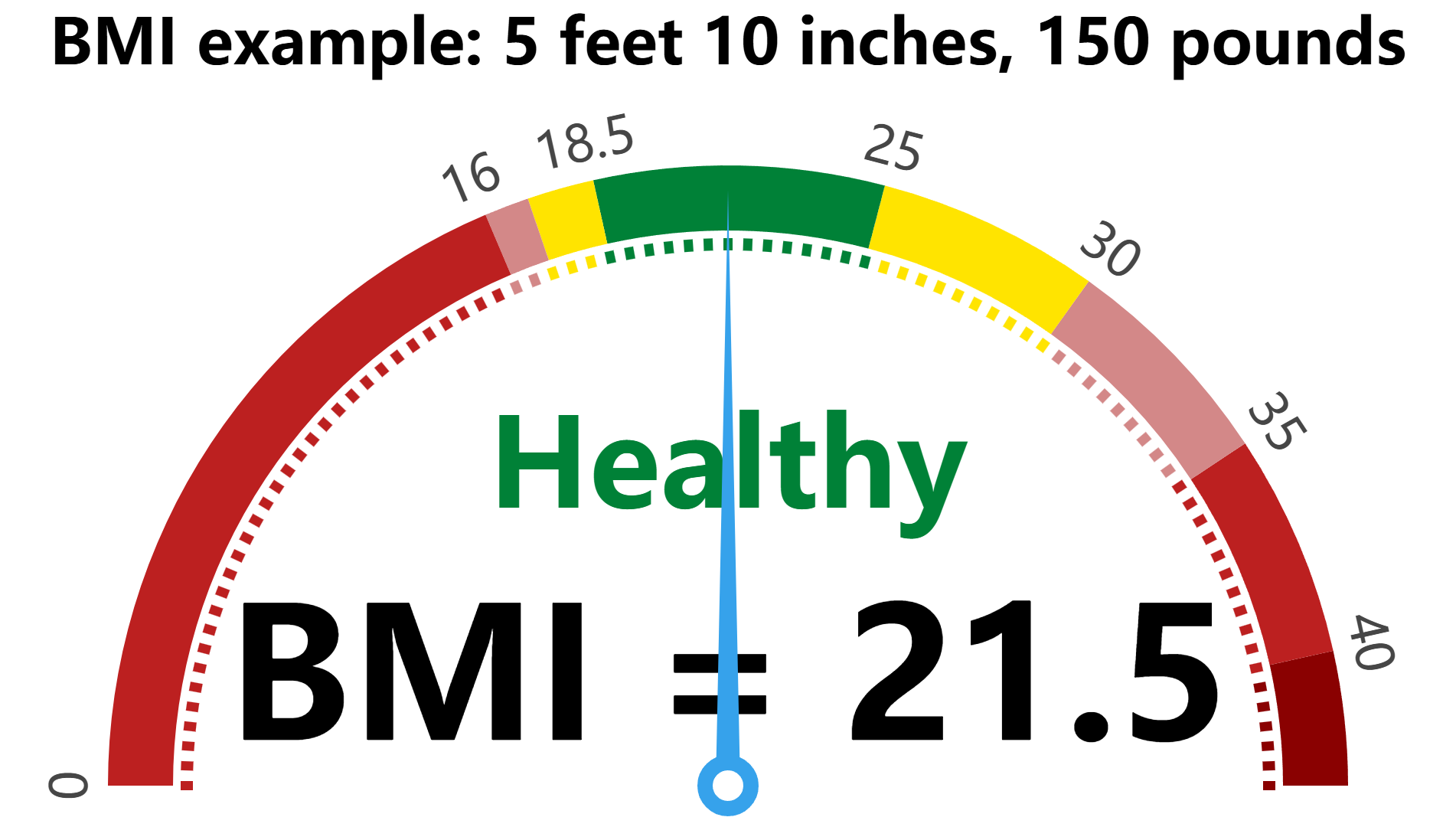
Height = 5 ft 10 in = 70 in
Weight = 150 lb
BMI = 703 × 150 / (70 × 70) = 21.5
BMI Prime = 21.5 / 25 = 0.86
Ponderal Index = 68.0 kg / (1.778 m × 1.778 m × 1.778 m) ≈ 12.1 kg/m³
Limitations of BMI
BMI is a screening tool, not a diagnosis. It does not directly measure body fat, muscle mass, bone density, fat distribution, cardiovascular fitness, or metabolic health.
Athletes and Muscular People
BMI can overestimate health risk in people with high muscle mass. A muscular person may have an overweight BMI while maintaining low body fat, strong cardiovascular fitness, and healthy blood markers.
Older Adults
BMI can underestimate risk in some older adults because muscle mass may decline with age. Two people with the same BMI can have different levels of muscle, balance, strength, and frailty risk.
Different Ethnic Backgrounds
BMI risk thresholds may not be identical across all populations. Some Asian populations may experience higher metabolic risk at lower BMI levels than standard international categories suggest. In these cases, waist circumference, waist-to-height ratio, blood glucose, and lipid markers become especially important.
Pregnancy and Children
This adult BMI calculator is not designed for pregnancy or for children and teenagers. Pediatric BMI is interpreted by age and sex percentiles, while pregnancy weight assessment requires pregnancy-specific guidance.
Better Health Metrics to Use With BMI
For a more complete picture, consider combining BMI with other measurements:
| Metric | What It Adds | Why It Matters |
|---|---|---|
| Waist circumference | Abdominal fat estimate | Central fat is more strongly linked with metabolic risk. |
| Waist-to-height ratio | Body shape context | Useful for comparing people of different heights. |
| Body fat percentage | Fat mass estimate | Helps distinguish muscle weight from fat weight. |
| Blood pressure | Cardiovascular risk marker | High blood pressure may occur even at a normal BMI. |
| Blood glucose and A1C | Diabetes risk markers | Important for identifying insulin resistance and diabetes risk. |
| Cholesterol and triglycerides | Blood lipid profile | Helps assess heart and metabolic health. |
FAQs
Is BMI accurate?
BMI is reasonably useful for population-level screening and quick adult weight classification, but it is not perfectly accurate for individuals. It does not show how much of your weight is fat, muscle, water, or bone.
Is BMI different for men and women?
The standard adult BMI formula is the same for men and women. However, body fat distribution and typical body composition can differ, so BMI should be interpreted with other measurements.
Can BMI affect life insurance rates?
Yes, it can. Many insurers use height and weight tables during underwriting. BMI may influence rate class, but it is usually considered alongside medical history, lab results, smoking status, and other risk factors.
Why does this calculator show BMI Prime?
BMI Prime makes BMI easier to compare with the common upper healthy cutoff of 25. A BMI Prime above 1.0 means BMI is above 25, while a value below 1.0 means BMI is below 25.
Why does this calculator show Ponderal Index?
Ponderal Index may provide extra context for very tall or very short people because it compares weight with height cubed instead of height squared. It does not replace BMI, but it can help highlight cases where BMI may be less proportional.
Medical and Financial Disclaimer
This calculator is for educational purposes only. It does not provide medical diagnosis, treatment advice, insurance underwriting decisions, or financial advice. If your result concerns you, speak with a qualified healthcare professional. If you are applying for life insurance, compare underwriting rules and quotes from licensed insurance providers or agents.
References
- CDC - About Adult BMI: https://www.cdc.gov/bmi/adult-calculator/index.html
- NIH / NHLBI - Assessing Your Weight and Health Risk: https://www.nhlbi.nih.gov/health/educational/lose_wt/risk.htm
- CDC - Healthy Weight, Nutrition, and Physical Activity: https://www.cdc.gov/healthyweight/index.html
- World Health Organization - Obesity and Overweight: https://www.who.int/news-room/fact-sheets/detail/obesity-and-overweight
- WHO Expert Consultation - Appropriate BMI for Asian Populations: https://pubmed.ncbi.nlm.nih.gov/14726171/
Write Reply to This Calculator