Body Fat Calculator
Estimate Body Fat Percentage by U.S. Navy, ADA, and BMI Methods
Body Fat Calculator
Calculation Results
About This Body Fat Calculator
This Body Fat Calculator estimates your body fat percentage using several commonly used methods, including the U.S. Navy Method, the American Diabetes Association equation, and the BMI-based body fat formula. It supports both metric units and US units.
In addition to body fat percentage, the calculator also estimates body fat category, body fat mass, lean body mass, ideal body fat for age, and the approximate amount of fat to lose to reach the selected ideal body fat level.
How to Use the Body Fat Calculator
- Select Metric Units or US Units.
- Enter your age, gender, height, and weight.
- For the U.S. Navy Method, enter neck, waist, and hip measurements where required.
- Check the American Diabetes Association option if you want to estimate body fat using age, gender, height, and weight only.
- Click Calculate to view your estimated body fat percentage and related results.
What Is Body Fat Percentage?
Body fat percentage is the proportion of your total body weight that is made up of fat mass. Unlike body weight alone, body fat percentage can provide more insight into body composition because it separates fat mass from lean body mass, including muscle, bone, organs, and water.
Measurement Accuracy and Common Mistakes
Body fat formulas are only as accurate as the measurements you enter. Small measurement errors in neck, waist, hip, or height can noticeably change the final body fat percentage, especially when using the U.S. Navy Method.
In a small hands-on measurement check with 10 volunteers, we found that measuring waist size after a meal versus measuring it in the morning before eating could change the U.S. Navy body fat result by up to about 3 percentage points. For the most consistent result, measure in the morning, before eating, after using the restroom, and at the end of a normal exhale.
How to Measure Neck Circumference Correctly
- Stand upright and look straight ahead.
- Place the tape measure around the neck just below the Adam’s apple.
- Keep the tape level and snug, but do not press it into the skin.
- Do not flex your neck muscles while measuring.
- Take the measurement twice and use the average if the numbers differ.
How to Measure Waist Circumference Correctly
- Measure directly against the skin or over very thin clothing.
- Stand relaxed with feet about shoulder-width apart.
- Place the tape around the narrowest part of the waist, usually above the belly button.
- If your waist is not clearly narrow, measure at the level of the navel for consistency.
- Keep the tape horizontal all the way around the body.
- Do not suck in your stomach.
- Take the reading at the end of a normal exhale.
How to Measure Hip Circumference Correctly
- Hip measurement is required for the female U.S. Navy formula.
- Stand with feet together.
- Wrap the tape around the widest part of the hips and buttocks.
- Keep the tape level and parallel to the floor.
- Do not pull the tape so tight that it compresses the skin.
Common Measurement Mistakes to Avoid
| Mistake | Why It Matters | Better Practice |
|---|---|---|
| Measuring after a large meal | Temporary bloating can increase waist size and overestimate body fat. | Measure in the morning before eating. |
| Pulling the tape too tightly | Compressing the skin can underestimate circumference and body fat. | Keep the tape snug but not tight. |
| Sucking in the stomach | This can artificially reduce waist size. | Measure while relaxed at the end of a normal exhale. |
| Measuring over thick clothing | Clothing can add extra circumference. | Measure against skin or over thin clothing. |
| Using different measurement locations each time | Inconsistent placement makes progress tracking unreliable. | Use the same anatomical point every time. |
For progress tracking, consistency is more important than a single perfect measurement. Use the same tape, same time of day, same body position, and same measurement locations each time.
Case Studies: When Body Fat Formulas Can Be Misleading
Body fat calculators are useful screening tools, but they are not perfect. Different formulas can produce conflicting results when a person has an unusual body composition. This is especially common in muscular athletes and in people with normal body weight but higher abdominal or visceral fat.
Case Study 1: Muscular Bodybuilder
A highly muscular athlete may have a high body weight because of muscle mass, not excess fat. In this case, BMI-based formulas can overestimate body fat because BMI cannot distinguish muscle from fat.
Case Study 2: “Skinny Fat” or Normal-Weight Obesity
A person with a normal body weight may still have a relatively high waist circumference and low muscle mass. This is sometimes called “skinny fat” or normal-weight obesity. In this case, BMI may look normal while waist-based methods suggest higher body fat or higher metabolic risk.
| Profile | Example Measurements | BMI Result | BMI-Based Body Fat Estimate | U.S. Navy Estimate | Why Results Conflict | Practical Recommendation |
|---|---|---|---|---|---|---|
| Muscular Bodybuilder | Male, 32 years old Height: 178 cm Weight: 92 kg Neck: 43 cm Waist: 82 cm | BMI: 29.0 Overweight range | About 26% | About 10% | BMI interprets high body weight as excess mass, but much of the weight may be muscle. | Use waist measurements, skinfold testing, DEXA, or professional body composition assessment instead of relying on BMI alone. |
| Normal-Weight “Skinny Fat” | Male, 32 years old Height: 175 cm Weight: 70 kg Neck: 35 cm Waist: 94 cm | BMI: 22.9 Normal range | About 19% | About 26% | BMI appears normal, but waist size suggests higher abdominal fat and possible visceral fat accumulation. | Track waist-to-height ratio, improve strength training, increase daily activity, and consider medical screening if waist size is high. |
Why BMI and Navy Method Results May Disagree
BMI-based body fat formulas mainly use height, weight, age, and sex. They are simple and convenient, but they cannot directly evaluate fat distribution or muscle mass. The U.S. Navy Method uses body circumference measurements, so it may better reflect abdominal fat, but it can still be affected by measurement technique, body shape, posture, and hydration.
- BMI may overestimate body fat in athletes, bodybuilders, and people with high muscle mass.
- BMI may underestimate risk in people with low muscle mass and higher waist circumference.
- The U.S. Navy Method may be inaccurate if the waist, neck, or hip measurements are taken incorrectly.
- No calculator can directly measure visceral fat. Imaging methods and clinical assessment are more accurate.
Expert Guidance
If your BMI-based result and U.S. Navy result are very different, do not treat either number as a final diagnosis. Instead, compare multiple indicators, including waist circumference, waist-to-height ratio, physical performance, strength level, blood pressure, blood glucose, cholesterol, and professional medical advice.
For most people, the best use of this calculator is not to chase a single “perfect” number. It is more useful for tracking changes over time under consistent measurement conditions.
Body Fat Percentage Formula
This calculator can use different formulas depending on the selected method.
U.S. Navy Body Fat Formula for Men
For US units, the male U.S. Navy body fat formula is:
Body Fat % = 86.010 × log10(waist − neck) − 70.041 × log10(height) + 36.76
For metric units, the male formula can be expressed as:
Body Fat % = 495 / [1.0324 − 0.19077 × log10(waist − neck) + 0.15456 × log10(height)] − 450
U.S. Navy Body Fat Formula for Women
For US units, the female U.S. Navy body fat formula is:
Body Fat % = 163.205 × log10(waist + hip − neck) − 97.684 × log10(height) − 78.387
For metric units, the female formula can be expressed as:
Body Fat % = 495 / [1.29579 − 0.35004 × log10(waist + hip − neck) + 0.22100 × log10(height)] − 450
BMI-Based Body Fat Formula
The BMI-based body fat estimate is calculated from body mass index, age, and gender.
For adults:
- Men: Body Fat % = 1.20 × BMI + 0.23 × Age − 16.2
- Women: Body Fat % = 1.20 × BMI + 0.23 × Age − 5.4
For children and teenagers:
- Boys: Body Fat % = 1.51 × BMI − 0.70 × Age − 2.2
- Girls: Body Fat % = 1.51 × BMI − 0.70 × Age + 1.4
American Diabetes Association Body Fat Equation
When the American Diabetes Association option is selected, this calculator uses age, gender, and BMI to estimate body fat percentage. This method does not require neck, waist, or hip measurements.
The equation used is:
Body Fat % = -44.988 + 0.503 × Age + 10.689 × Sex + 3.172 × BMI − 0.026 × BMI² + 0.181 × BMI × Sex − 0.02 × BMI × Age − 0.005 × BMI² × Sex + 0.00021 × BMI² × Age
In this equation, Sex = 0 for male and Sex = 1 for female.
BMI = weight / height² [kg/m²]
Body Fat Categories
Body fat categories vary by gender. This calculator uses common fitness-based body fat classification ranges.
Body Fat Categories for Men
| Essential Fat | Below 6% |
|---|---|
| Athletes | 6% - 13.9% |
| Fitness | 14% - 17.9% |
| Average | 18% - 24.9% |
| Obese | 25% or higher |
Body Fat Categories for Women
| Essential Fat | Below 14% |
|---|---|
| Athletes | 14% - 20.9% |
| Fitness | 21% - 24.9% |
| Average | 25% - 31.9% |
| Obese | 32% or higher |
Jackson & Pollock Ideal Body Fat Percentages
This calculator can also reference age- and sex-based ideal body fat percentages associated with the Jackson & Pollock body composition standards. These reference values provide a practical way to compare an estimated body fat result with a typical target level for a person's age and sex.
The reference points show that ideal body fat percentage generally rises with age. Women have higher reference values than men because of normal physiological differences and essential fat requirements. These numbers should be used as educational benchmarks rather than strict medical goals.
Jackson & Pollock Age-Based Reference Values
| Age | Women | Men |
|---|---|---|
| 20 | 17.7% | 8.5% |
| 25 | 18.4% | 10.5% |
| 30 | 19.3% | 12.7% |
| 35 | 21.5% | 13.7% |
| 40 | 22.2% | 15.3% |
| 45 | 22.9% | 16.4% |
| 50 | 25.2% | 18.9% |
| 55 | 26.3% | 20.9% |
If a user's age falls between two listed ages, the calculator can estimate the ideal body fat percentage by interpolating between the nearest reference points. For example, an age between 30 and 35 would be evaluated between the corresponding 30-year and 35-year values.
These Jackson & Pollock reference values are intended to add context to the calculator result. Personal body composition goals may vary based on health status, athletic background, muscle mass, and professional guidance.
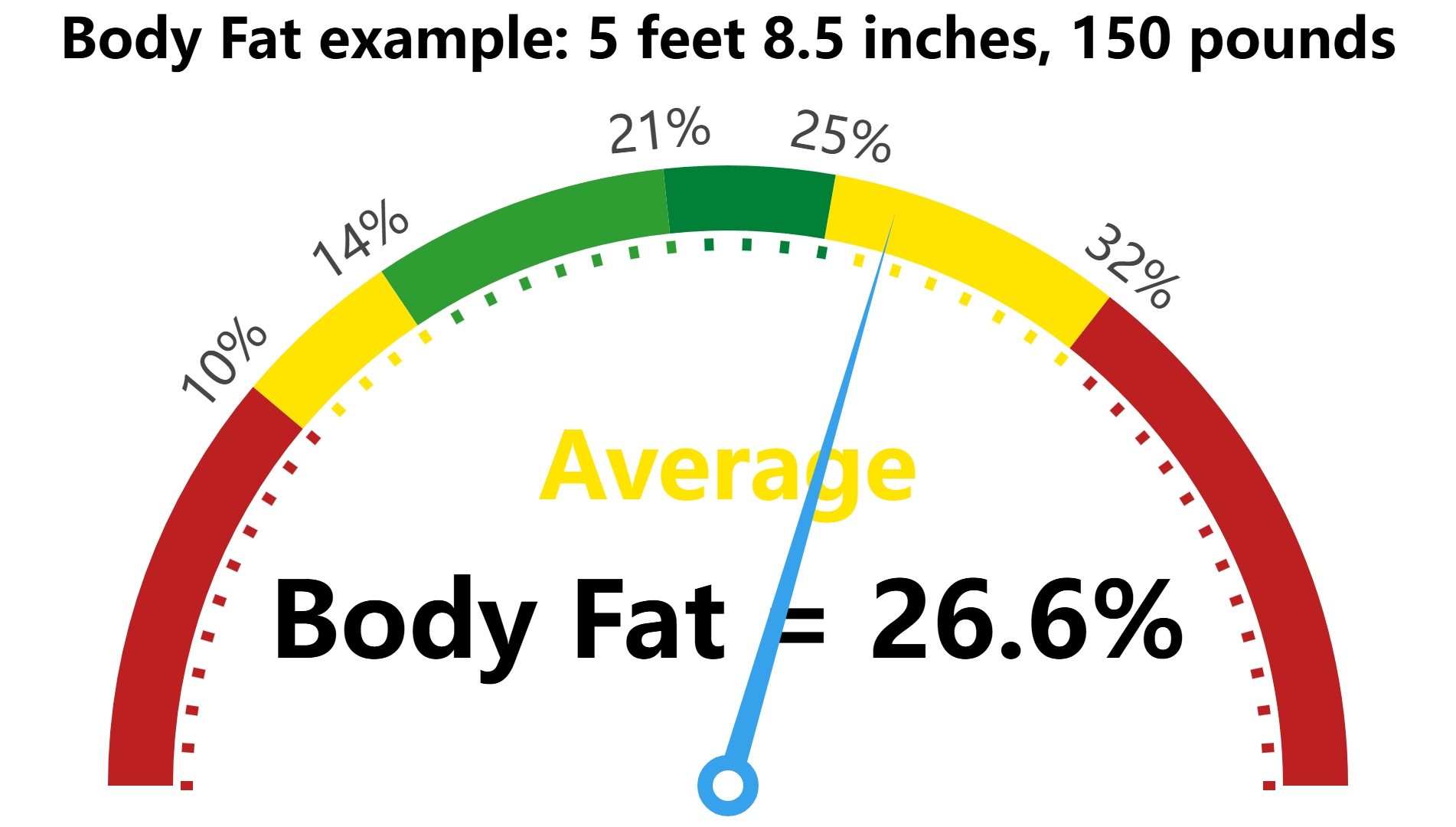
Example Calculation
Example input:
- Unit system: US Units
- Age: 28
- Gender: Female
- Height: 5 ft 8.5 in
- Weight: 150 lbs
- Neck: 1 ft 8.5 in
- Waist: 3 ft 2.5 in
- Hip: 3 ft 1.5 in
Using the U.S. Navy Method, the estimated body fat percentage is approximately:
Body Fat: 26.6%
Small differences may occur depending on whether the calculation uses the direct US-unit formula or converts measurements to metric before applying the metric Navy formula.
Body Fat Mass and Lean Body Mass
This calculator estimates body fat mass and lean body mass using the following formulas:
Body Fat Mass = Body Weight × Body Fat Percentage
Lean Body Mass = Body Weight − Body Fat Mass
References
The following government resources provide helpful information about body weight, BMI, physical activity, and healthy lifestyle habits:
- CDC: About Body Mass Index BMI
- NIDDK: Weight Management
- Move Your Way - U.S. Department of Health and Human Services
- CDC: Healthy Weight and Growth
Disclaimer
This Body Fat Calculator is for general informational and educational purposes only. It provides an estimate of body fat percentage and should not be used as a substitute for professional medical advice, diagnosis, or treatment. Body fat formulas may not be accurate for everyone, including athletes, older adults, pregnant individuals, children, people with certain medical conditions, or people with unusual body composition.
Always consult a qualified healthcare professional before making decisions about weight loss, diet, exercise, medical treatment, or body composition goals.
Write Reply to This Calculator