Annuity Growth Calculator - Calculate Future Value & Growth Projections

Annuity Growth Calculator

Year Month
per Year
per Month
Beginning (annuity due)
End (ordinary/immediate annuity)

Annuity Value Projection

End Balance
Total Return
Initial Balance
Total Addition Amount
Return from Initial Principal
Return from Addition Amount

Annuity Accumulation Schedule

Track your annuity growth month by month and year by year with comprehensive breakdowns showing contributions, interest earned, and ending balances.

Annuity Performance Analysis

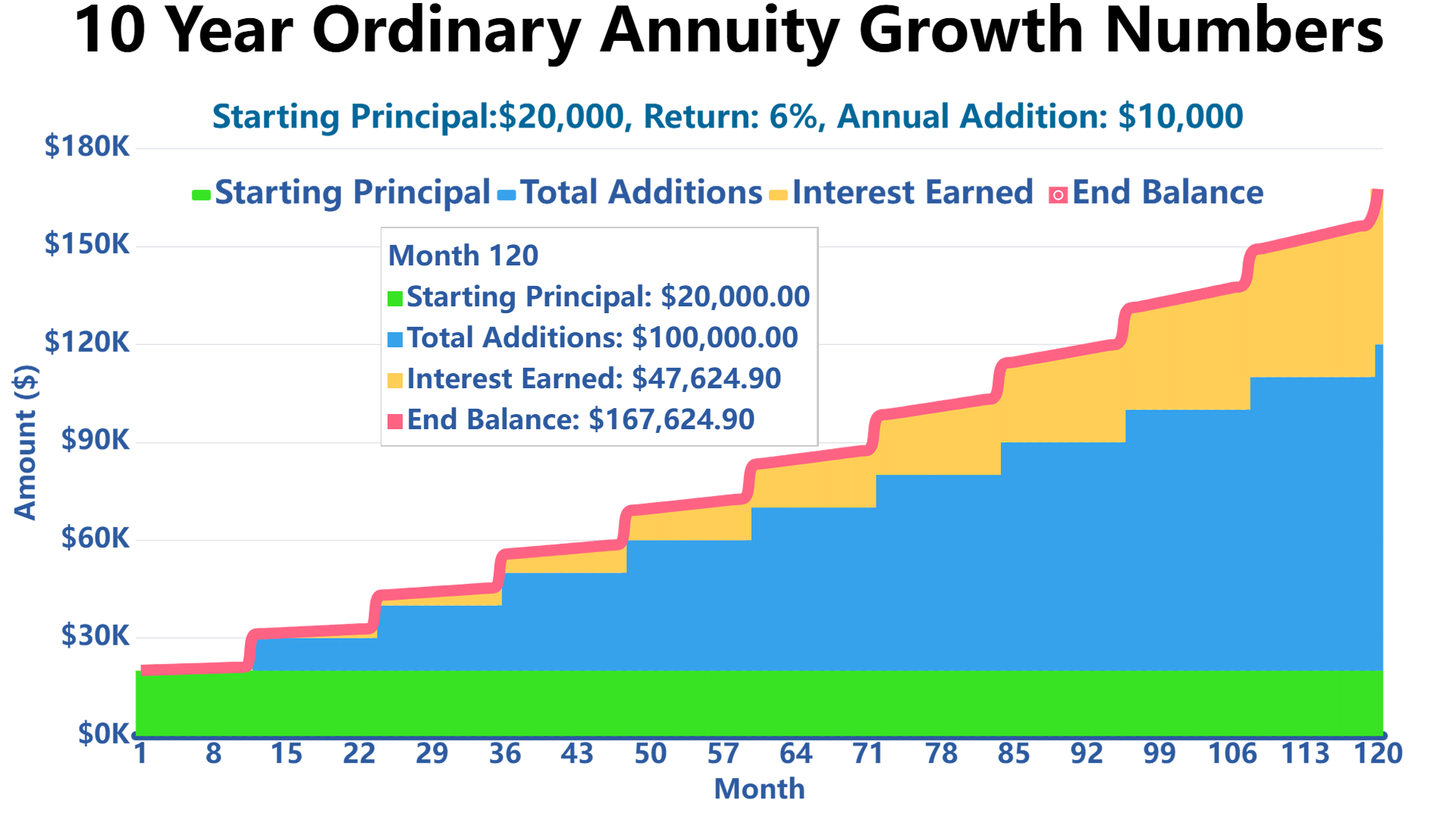
Visual representation of your annuity growth showing periodic contributions, balance progression, and compound interest accumulation over time.

Understanding Annuities: Types, Benefits, and Calculations

What is an Annuity?

An annuity is a financial product that provides a series of payments made at equal intervals. Annuities can be used for retirement planning, estate planning, or any situation where you want to receive regular income over time. According to the U.S. Securities and Exchange Commission (SEC), annuities are contracts between you and an insurance company in which the company promises to make periodic payments to you, either immediately or at some future date.

Types of Annuities

  • Immediate Annuities: Begin paying out immediately after purchase
  • Deferred Annuities: Accumulate value over time before payout begins
  • Fixed Annuities: Provide guaranteed fixed payments
  • Variable Annuities: Payments vary based on investment performance
  • Ordinary Annuities: Payments made at the end of each period
  • Annuities Due: Payments made at the beginning of each period

💡 Key Insight

The timing of when contributions are made (beginning vs. end of period) can significantly impact the final value of your annuity due to compound interest effects. Our calculator accounts for both scenarios.

Annuity Calculation Formulas

Future Value of Ordinary Annuity

FV = PMT × [((1 + r)ⁿ - 1) / r]

Where:

  • FV = Future Value
  • PMT = Periodic Payment Amount
  • r = Interest rate per period
  • n = Number of periods

Future Value of Annuity Due

FV = PMT × [((1 + r)ⁿ - 1) / r] × (1 + r)

This formula accounts for payments made at the beginning of each period, resulting in one additional period of compound growth.

Present Value with Initial Principal

Total FV = P × (1 + r)ⁿ + PMT × [((1 + r)ⁿ - 1) / r]

Where P = Initial Principal Amount

This combines the future value of a lump sum with the future value of an annuity.

Compound Interest Formula

A = P × (1 + r/n)^(nt)

Where:

  • A = Final amount
  • P = Principal amount
  • r = Annual interest rate (decimal)
  • n = Number of times interest compounds per year
  • t = Number of years

How to Use This Annuity Growth Calculator

Step-by-Step Instructions

  1. Enter Starting Principal: Input your initial investment amount in dollars. This could be a lump sum you're starting with or the initial value of your annuity.
  2. Set Annual Return Rate: Enter the expected annual rate of return as a percentage. For reference, the Social Security Administration uses long-term real interest rate assumptions of around 2.3-2.8% for planning purposes.
  3. Define the Term: Specify how long you plan to let the annuity grow, using both years and months for precision.
  4. Configure Additional Contributions:
    • Annual contributions: Lump sum added once per year
    • Monthly contributions: Regular monthly additions
    • You can use both types simultaneously
  5. Choose Payment Timing:
    • Beginning (Annuity Due): Payments made at the start of each period
    • End (Ordinary Annuity): Payments made at the end of each period
  6. Set Annual Increases: If you plan to increase your contributions annually (e.g., to keep pace with inflation), enter the percentage increase.
  7. Review Results: The calculator provides comprehensive breakdowns including charts, schedules, and downloadable reports.

Interpreting Your Results

  • End Balance: Total value of your annuity at maturity
  • Total Return: Amount earned through interest and compound growth
  • Return from Initial Principal: Interest earned specifically on your starting amount
  • Return from Additions: Interest earned on your periodic contributions

Retirement Planning with Annuities

Strategic Considerations

According to the U.S. Department of Labor, annuities can play an important role in retirement planning by providing guaranteed income streams.

Key Planning Factors:

  • Inflation Protection: Consider how inflation may erode purchasing power over time
  • Tax Implications: Understand the tax treatment of your annuity contributions and withdrawals
  • Liquidity Needs: Annuities may have surrender charges or withdrawal restrictions
  • Beneficiary Planning: Some annuities offer death benefits for estate planning

📊 Planning Tip

The IRS sets annual contribution limits for tax-advantaged retirement accounts. Consider maximizing these contributions before investing in non-qualified annuities.

Understanding Risks and Limitations

Investment Risks

  • Interest Rate Risk: Fixed annuities may underperform if interest rates rise
  • Inflation Risk: Fixed payments may lose purchasing power over time
  • Credit Risk: Payments depend on the insurance company's financial strength
  • Liquidity Risk: Early withdrawals may incur significant penalties

Calculator Limitations

This calculator provides educational estimates based on the inputs provided. Actual annuity performance may differ due to:

  • Market volatility and changing interest rates
  • Insurance company fees and charges not accounted for in basic calculations
  • Tax implications that vary by individual circumstances
  • Regulatory changes affecting annuity products

Regulatory Information and Resources

Government Resources

Professional Guidance

The SEC recommends consulting with qualified financial advisors when considering annuity purchases, as these products can be complex and may not be suitable for all investors.

Frequently Asked Questions

What's the difference between ordinary annuity and annuity due?

An ordinary annuity makes payments at the end of each period, while an annuity due makes payments at the beginning of each period. Annuity due typically results in higher future values due to the additional compounding time.

How accurate are these calculations?

Our calculator uses standard financial formulas and provides accurate results based on the inputs provided. However, actual investment returns may vary due to market conditions and fees.

Can I use this for retirement planning?

Yes, this calculator is excellent for retirement planning. You can model different contribution amounts and see how they grow over time to help plan your retirement savings strategy.

Related

Write Reply

Leave a Reply

Your email address will not be published. Required fields are marked *

^