USDA Mortgage Calculator
Estimate your USDA loan payment, guarantee fees, taxes, insurance, and long-term ownership cost.
USDA Mortgage Calculator
Calculation Results
| Item | Monthly | Annual | Total |
|---|---|---|---|
| Mortgage Payment | |||
| Property Tax | |||
| Home Insurance | |||
| USDA Annual Fee | |||
| HOA Fee | |||
| Other Costs | |||
| Total Buyer Costs |
Payment Schedule Visualization
Payment Amortization Table
| Year | Date | Interest | Principal | Payment | Annual Fee | Ending balance | Cumulative Payment | Cumulative Principal |
|---|
| Month | Date | Interest | Principal | Payment | Annual Fee | Ending balance | Cumulative Payment | Cumulative Principal |
|---|
What Is the USDA Annual Guarantee Fee?
In addition to the upfront fee, USDA loans include an annual guarantee fee, currently set at 0.35% of the remaining loan principal balance. You don't pay this fee in one lump sum; instead, it's divided into 12 monthly payments and built directly into your mortgage payment, making it easier to budget.
Example Calculation:
Initial Loan: If your initial loan balance is $300,000, the 0.35% rate equals $1,050 per year, or approximately $87.50 per month.
After 5 Years: As you pay down your loan, this fee decreases as well. After five years, your loan balance might be around $200,000, at which point the annual fee drops to $700, or approximately $58.33 per month.
Note: The annual guarantee fee automatically adjusts as your loan balance decreases over time, meaning you'll pay less each year as you build equity in your home.
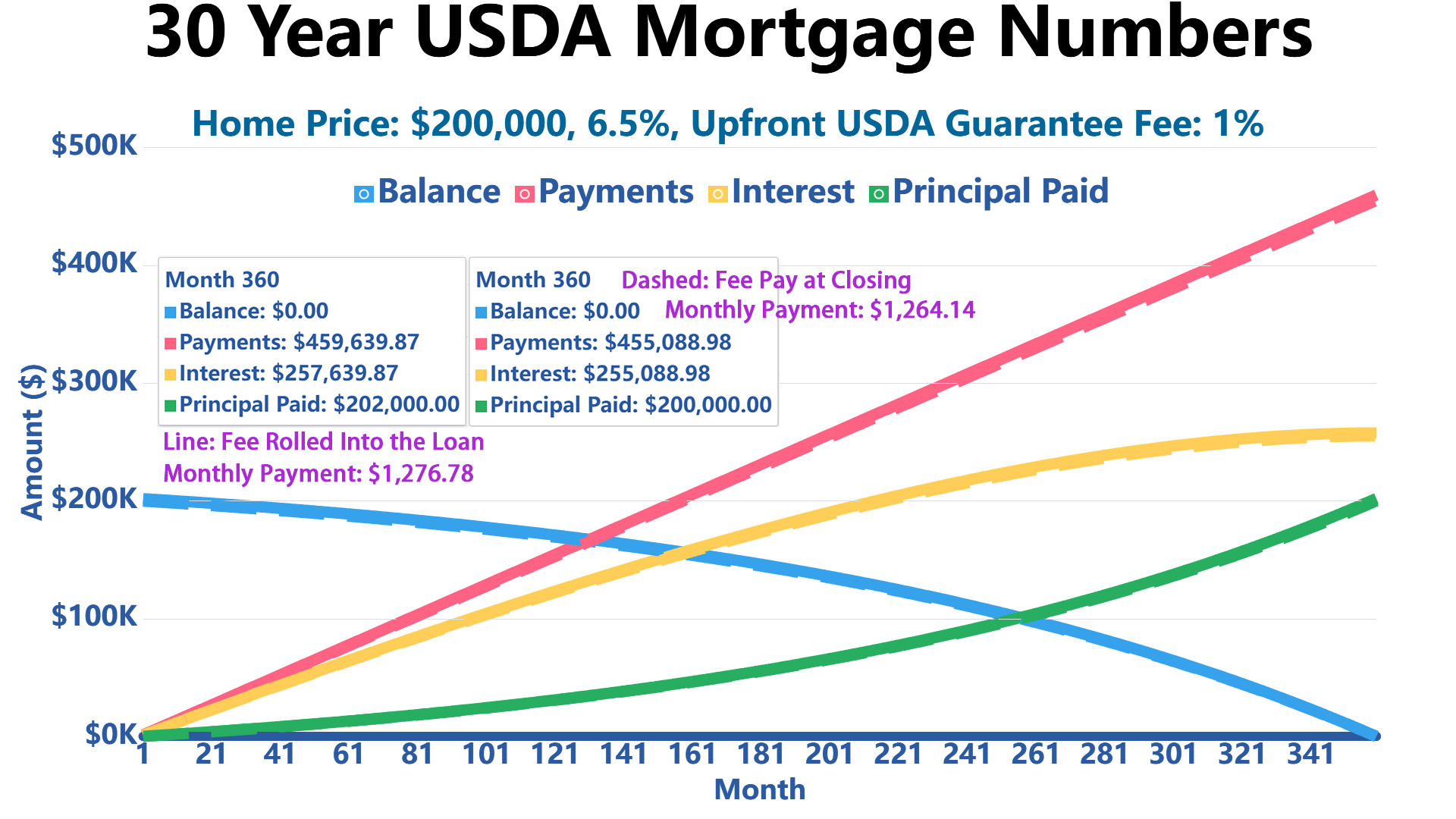
Expert Mortgage Strategy: Should You Roll the USDA Guarantee Fee Into the Loan?
From a mortgage analyst’s perspective, the USDA upfront guarantee fee is not just a technical closing-cost item. It changes your cash-to-close, your financed balance, your long-term interest cost, and your flexibility after closing. The right choice depends less on the fee itself and more on your liquidity, emergency reserves, and expected time in the home.
Option 1: Roll the 1% USDA Guarantee Fee Into the Loan
Rolling the upfront fee into the mortgage is usually the more practical choice for buyers who are using USDA financing because they want to preserve cash. USDA loans are often attractive precisely because they allow low or zero down payment, so keeping more money available after closing can be valuable.
- Best for: buyers with limited cash reserves, first-time homebuyers, and borrowers who want to keep emergency savings intact.
- Main advantage: lower cash required at closing.
- Main drawback: the fee becomes part of the loan balance, so you pay interest on it over time.
- Editorial view: if paying the fee upfront would leave you with less than three to six months of emergency savings, financing the fee is usually the safer household-budget decision.
Option 2: Pay the USDA Guarantee Fee at Closing
Paying the fee at closing reduces your financed loan amount and slightly lowers your monthly principal-and-interest payment. It also avoids paying mortgage interest on the guarantee fee over the life of the loan.
- Best for: buyers with strong savings, stable income, and enough cash left after closing.
- Main advantage: lower loan balance and less total interest over the full term.
- Main drawback: higher amount due at signing.
- Editorial view: paying upfront can make sense if you plan to keep the home and mortgage for many years and still have healthy cash reserves after closing.
My Practical Rule of Thumb
If paying the guarantee fee at closing weakens your emergency fund, roll it into the loan. If your savings remain strong after closing and you expect to hold the mortgage long term, paying it upfront can reduce total borrowing cost. For most USDA borrowers, preserving liquidity is often more important than saving a small amount of monthly interest.
USDA Loan Eligibility: Income Limits and Property Location Matter
USDA loans are not available to every borrower or every property. Two of the most important approval filters are household income limits and property eligibility. A buyer can have strong credit and still fail to qualify if the household income is too high or the home is outside a USDA-eligible area.
1. USDA Income Limits
USDA loans are designed for low-to-moderate income households. The income limit is based on:
- The county or eligible area where the property is located
- The number of people in the household
- Total household income, not only the income of the borrowers on the loan
- Allowable deductions, such as certain childcare, dependent, elderly, or disability-related deductions
This is an important distinction. With many mortgage programs, lenders primarily evaluate the income of the applicants. USDA may also consider income from other adult household members, even if they are not on the mortgage note.
Editorial note: before you shop for homes, verify your income eligibility using the USDA income tool. Many buyers waste time comparing USDA payments only to discover later that household income exceeds the local program limit.
2. USDA Property Eligibility
USDA financing is intended for eligible rural and suburban communities. “Rural” does not always mean remote farmland. Many small towns and outer-suburban areas may qualify, while some fast-growing suburban neighborhoods may not.
Property eligibility depends on the specific address. A home across the street from an eligible area may be ineligible, so always verify the property address through the official USDA eligibility map.
3. Why Eligibility Should Be Checked Before Rate Shopping
USDA loans can be very cost-effective, but only if both the borrower and the property qualify. Before comparing USDA against FHA or conventional loans, confirm these three items:
- Your household income is within the USDA limit for the area.
- The property address is USDA eligible.
- Your lender actively originates USDA Guaranteed Loans.
Reference Sources
This calculator is based on official USDA Rural Development program guidelines. For the most current and detailed information, please refer to these authoritative government sources:
USDA Rural Development - Single Family Housing Guaranteed Loan Program
Official program homepage with eligibility requirements, property guidelines, and application information.
Visit: www.rd.usda.gov/programs-services/single-family-housing-guaranteed-loan-programUSDA Property Eligibility Map
Check if a specific property address is located in a USDA-eligible rural area.
Visit: eligibility.sc.egov.usda.gov
Write Reply to This Calculator