Retirement Withdrawal Calculator
How Much Can You Withdraw Monthly?
Monthly Retirement Withdrawal Calculator
Calculation Results
Pre-Retirement Accumulation Table
Retirement Withdrawal Plan - Fixed Dollar
| Month | Age | Starting Balance | Interest Earned | Withdrawn Amonut | Remaining Balance | Principal Withdrawn | Cumulative Principal | Cumulative Interest | Cumulative Withdrawn |
|---|
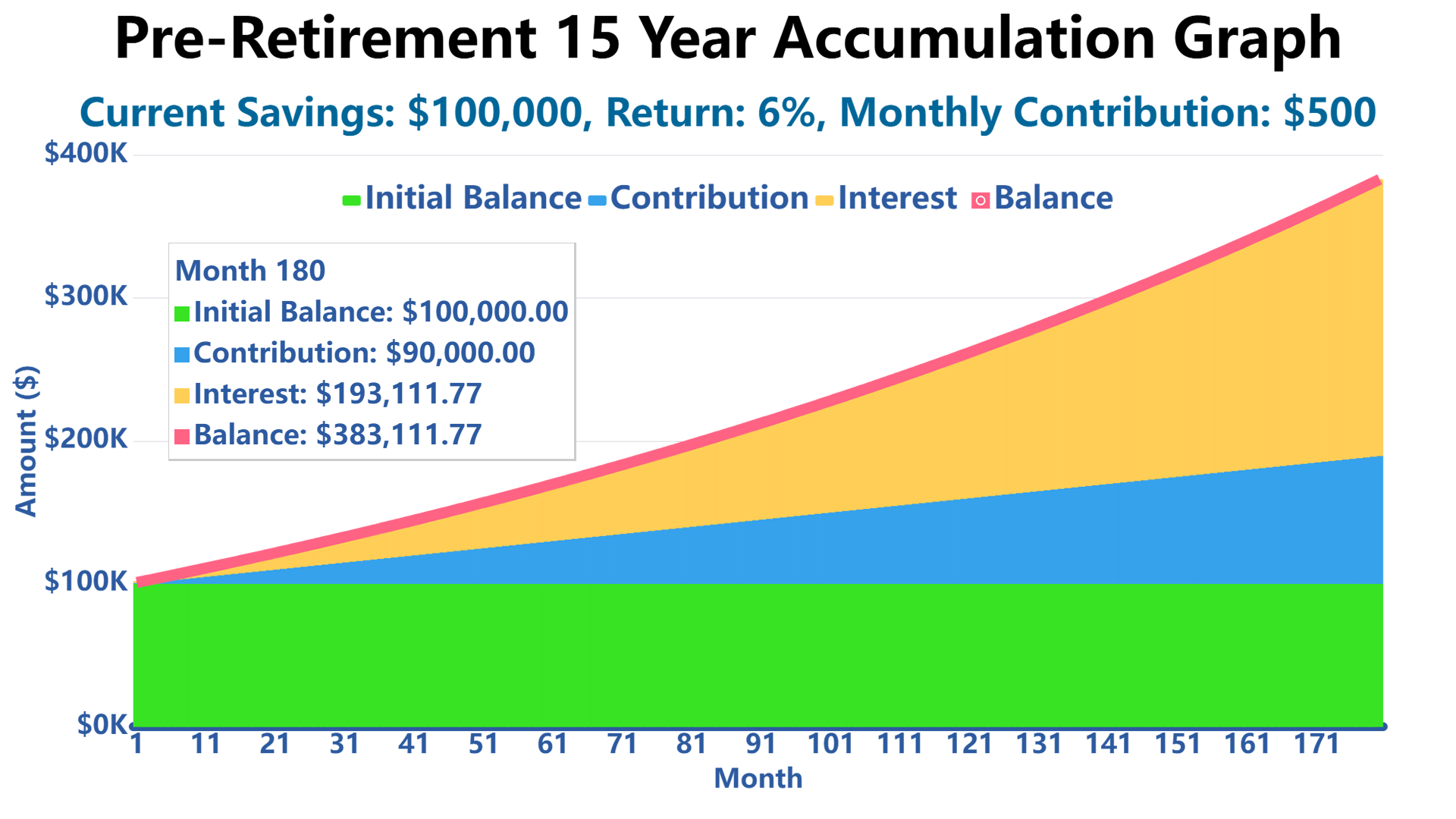
Visualizing Retirement Savings Growth
How Much Can I Withdraw After Retirement?
Let’s say you:
- Your age now: 60
- Your planned retirement age: 67
- Your life expectancy: 80
- Your retirement savings today: $600,000
- Average investment return: 6%
- Inflation rate (annual): 3%
- Retirement Tax Rate: 0%
Based on your retirement savings of $600,000 at age 60, with a 6% average return and 3% inflation, your savings will grow to $902,178.16 by age 67 (equivalent to $733,553.40 in today’s dollars).
If you withdraw a amount adjusted for 3% inflation annually, you can start by withdrawing $6,973.90 per month at retirement (equivalent to $5,670.42 in today’s dollars).
Alternatively, if you withdraw a fixed monthly amount without inflation adjustment, you can withdraw $8,267.55 per month from age 67 to 80, which equals $6,722.27 in today’s dollars at retirement and decreases to $4,577.54 in today’s dollars by age 80.
For more detailed data, please use the calculator on this page to perform the calculations and view the results and tables.
Can I Retire at 60 With 500k in Savings?
Let’s say you:
- Your age now: 60
- Your planned retirement age: 60
- Your life expectancy: 85
- Expected Annual Return: 6%
- Inflation rate (annual): 3%
- Retirement Tax Rate: 0%
Based on your retirement savings of $500,000 at age 60.
If you withdraw a amount adjusted for 3% inflation annually, you can start by withdrawing $2,360.54 per month at retirement.
Alternatively, if you withdraw a fixed monthly amount without inflation adjustment, you can withdraw $3,173.10 per month from age 60 to 85.
Achieving a comfortable retirement with $500,000 is possible. This sum allows for an annual withdrawal of approximately $38,077, which can last for 25 years, from age 60 to 85. If you can live on around $3,000 each month, then $500,000 provides a solid financial foundation for a secure retirement.
Is $2 Million Enough to Retire on at 50?
Let’s say you:
- Your age now: 50
- Your planned retirement age: 50
- Your life expectancy: 85
- Expected Annual Return: 6%
- Inflation rate (annual): 3%
- Retirement Tax Rate: 0%
Based on your retirement savings of $2,000,000 at age 50.
If you withdraw a amount adjusted for 3% inflation annually, you can start by withdrawing $7,651.90 per month at retirement.
Alternatively, if you withdraw a fixed monthly amount without inflation adjustment, you can withdraw $11,191.12 per month from age 50 to 85.
Retiring comfortably with $2 million is achievable. With this amount, you can withdraw about $134,293.50 per year, sustaining your finances for 35 years between ages 50 and 85. If your yearly expenses are close to $130,000 annually, or about $11,000 monthly, a $2 million nest egg offers a strong base for a financially stable retirement.
Can I Retire at 50 With $1 Million Dollars?
Let’s say you:
- Your age now: 50
- Your planned retirement age: 50
- Your life expectancy: 85
- Expected Annual Return: 6%
- Inflation rate (annual): 3%
- Retirement Tax Rate: 0%
Based on your retirement savings of $1,000,000 at age 50.
If you withdraw a amount adjusted for 3% inflation annually, you can start by withdrawing $3,825.95 per month at retirement.
Alternatively, if you withdraw a fixed monthly amount without inflation adjustment, you can withdraw $5,595.56 per month from age 50 to 85.
Living comfortably in retirement with $1 million is attainable. This sum allows for an annual withdrawal of approximately $67146.75, which can support your expenses over a 35-year period from age 50 to 85. If your annual spending is around $65,000, or roughly $5,000 per month, having $1 million saved provides a solid financial foundation for a secure and steady retirement.
References
Government Resources
- Social Security Administration - Retirement Planning
- U.S. Department of Labor - Retirement Planning
- Internal Revenue Service - Retirement Plans
- SEC Investor.gov - Retirement Plans
- Consumer Financial Protection Bureau - Retirement Tools
Write Reply to This Calculator