Addition Calculator
Add two or more numbers online and see the result with clear step-by-step addition work.
Addition Calculator
What Is an Addition Calculator?
This addition calculator is a simple online tool for adding two or more numbers. It supports whole numbers and decimals, and it can calculate the sum of up to 10 addends.
The calculator is useful for checking arithmetic homework, adding prices, combining measurements, counting totals, and learning how column addition works.
How to Use the Addition Calculator
- Select how many addends you want to add.
- Enter each number in the input boxes.
- Click the “Calculate” button.
- Review the sum and the step-by-step calculation.
Addition Formula
Addition combines multiple addends into one total called the sum.
Sum = a1 + a2 + a3 + ... + an
Example:
19 + 36 = 55
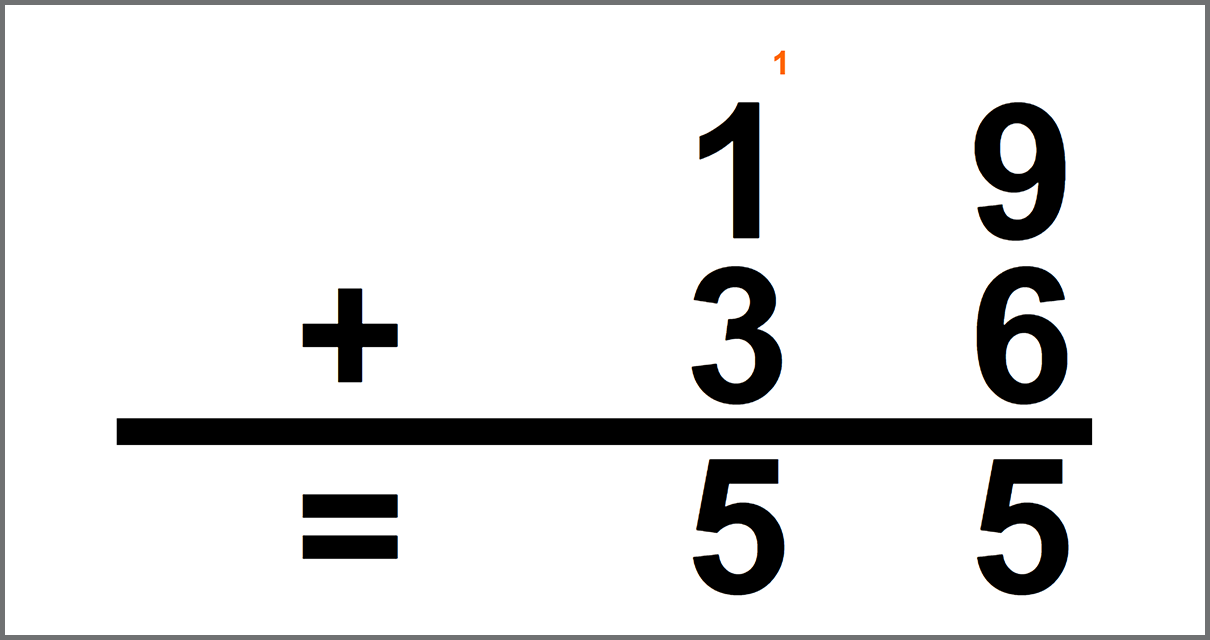
Example: 19 + 36
To calculate 19 + 36, use vertical addition:
- Add the ones column: 9 + 6 = 15. Write 5 and carry 1.
- Add the tens column: 1 + 3 + 1 carried = 5.
- The final sum is 55.
So, 19 + 36 = 55.
How the Calculator Works
The calculator first checks whether each input is a valid number. It then converts the values into a precise internal format so that whole numbers and decimals can be added accurately.
For decimal addition, the calculator aligns decimal places before adding. This ensures that tenths, hundredths, thousandths, and other place values are added correctly.
Principle of Addition
Addition is based on place value. Each digit has a position, such as ones, tens, hundreds, tenths, or hundredths. When adding numbers, digits in the same place value are added together.
If the total in a column is 10 or more, a carry is moved to the next column on the left. This is called carrying and is a key part of standard vertical addition.
Adding Whole Numbers
When adding whole numbers, start from the rightmost digit and move left one column at a time. Add each column, write the ones digit of the column total, and carry any tens value to the next column.
Adding Decimal Numbers
Decimal numbers are added by lining up the decimal points. After the decimal points are aligned, each column is added from right to left just like whole-number addition.
For example:
12.50 + 3.75 = 16.25
Properties of Addition
Addition has several important properties that make it easier to understand and simplify arithmetic problems. These properties are commonly used in basic math, mental calculation, algebra, and problem solving.
Commutative Property of Addition
The commutative property means that changing the order of the addends does not change the sum.
a + b = b + a
Example:
19 + 36 = 36 + 19 = 55
Associative Property of Addition
The associative property means that when adding three or more numbers, changing the grouping of the addends does not change the sum.
(a + b) + c = a + (b + c)
Example:
(2 + 3) + 4 = 2 + (3 + 4) = 9
Identity Property of Addition
The identity property means that adding zero to a number does not change the number.
a + 0 = a
Example:
55 + 0 = 55
Additive Inverse Property
The additive inverse property means that a number plus its opposite equals zero.
a + (-a) = 0
Example:
36 + (-36) = 0
Closure Property of Addition
The closure property means that adding two numbers from the same number set often produces another number in that same set. For example, the sum of two whole numbers is also a whole number.
Example:
19 + 36 = 55
Since 19 and 36 are whole numbers, and 55 is also a whole number, whole numbers are closed under addition.
Reference
For additional educational information about mathematics learning, visit the U.S. Department of Education.
FAQs
What is an addition calculator?
An addition calculator is an online tool that adds two or more numbers and displays the total sum.
Can this calculator add decimal numbers?
Yes. This calculator supports decimal numbers and aligns decimal places before adding them.
What are addends?
Addends are the numbers being added together in an addition problem.
What is the sum?
The sum is the result obtained after adding two or more numbers.
How do you calculate 19 + 36?
To calculate 19 + 36, add the ones column first: 9 + 6 = 15, write 5 and carry 1. Then add the tens column: 1 + 3 + 1 = 5. The result is 55.
Write Reply to This Calculator