Long Division Calculator
This long division calculator helps you divide whole numbers and decimals while showing the work step by step.
Long Division Calculator
| = ? | |||
How to Calculate a Long Division Problem
Long division is a step-by-step way to divide a large number. The number being divided is the dividend, and the number you divide by is the divisor.
Example: in 200 ÷ 13, 200 is the dividend and 13 is the divisor.
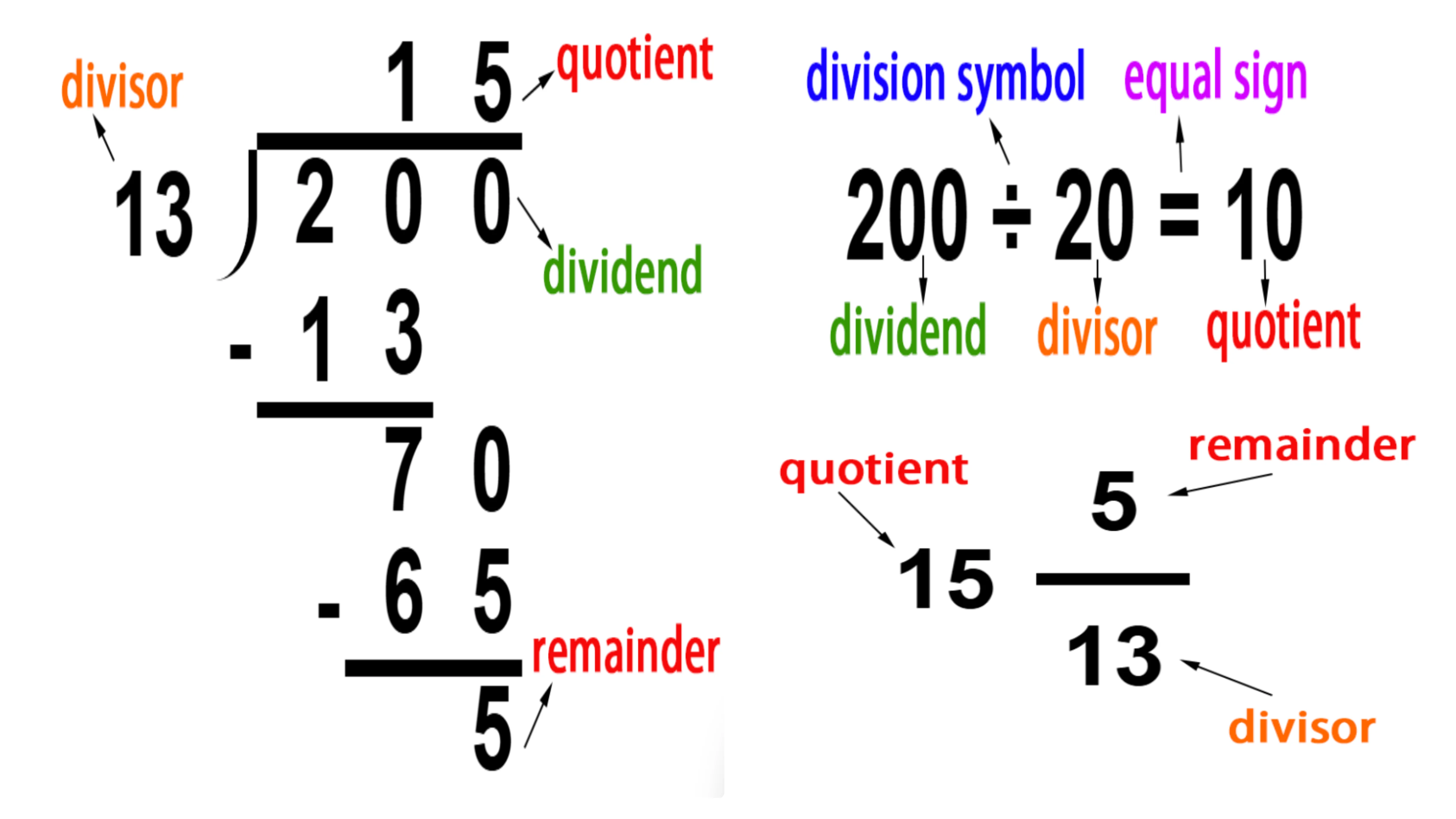
In written long division, place the dividend inside the division bracket and the divisor on the outside. Then follow a repeating pattern: divide, multiply, subtract, and bring down the next digit.
| 13 | 2 | 0 | 0 | ||
Step 1: Find the first number the divisor can fit into
Start from the left side of the dividend. In 200 ÷ 13, the first digit is 2. Since 13 cannot fit into 2, look at the first two digits: 20.
| 0 | |||||
| 13 | 2 | 0 | 0 | ||
Some teachers write a zero above the first digit. Others begin the quotient above the digit where the actual division starts. Both layouts are common.
Step 2: Divide and write the first quotient digit
Ask: how many times does 13 fit into 20? It fits 1 time.
| 0 | 1 | ||||
| 13 | 2 | 0 | 0 | ||
| 1 | 3 | ||||
Write 1 in the quotient, then multiply: 13 × 1 = 13.
Step 3: Subtract and bring down the next digit
Subtract 13 from 20: 20 - 13 = 7.
| 0 | 1 | ||||
| 13 | 2 | 0 | 0 | ||
| - | 1 | 3 | ↓ | ||
| 7 | 0 | ||||
Then bring down the next digit, which is 0. Now the working number becomes 70.
Step 4: Repeat divide, multiply, and subtract
Now ask: how many times does 13 fit into 70? It fits 5 times because 13 × 5 = 65.
Subtract: 70 - 65 = 5.
| 0 | 1 | 5 | |||
| 13 | 2 | 0 | 0 | ||
| - | 1 | 3 | ↓ | ||
| 7 | 0 | ||||
| - | 6 | 5 | |||
| 5 | |||||
So the whole-number result is: 200 ÷ 13 = 15 remainder 5.
Step 5: Continue into decimals if needed
If you want a decimal answer, add a decimal point after the quotient and bring down a zero. The remainder 5 becomes 50.
| 0 | 1 | 5 | . | 3 | |||
| 13 | 2 | 0 | 0 | ||||
| - | 1 | 3 | ↓ | ||||
| 7 | 0 | ||||||
| - | 6 | 5 | ↓ | ||||
| 5 | 0 | ||||||
| - | 3 | 9 | |||||
| 1 | 1 | ||||||
Then continue the same pattern. For this example: 200 ÷ 13 = 15.384615384615....
| 0 | 1 | 5 | . | 3 | 8 | |||
| 13 | 2 | 0 | 0 | |||||
| - | 1 | 3 | ↓ | |||||
| 7 | 0 | |||||||
| - | 6 | 5 | ↓ | |||||
| 5 | 0 | |||||||
| - | 3 | 9 | ↓ | |||||
| 1 | 1 | 0 | ||||||
| - | 1 | 0 | 4 | |||||
| 6 | ||||||||
Why Students Often Get Long Division Wrong
Long division is not hard because of one single operation. It becomes tricky because students must keep track of several small steps in the correct order. Here are the most common mistakes and how to avoid them.
1. Forgetting to bring down a zero
When continuing into decimals, students often forget to add or bring down a zero after the decimal point.
Fix: If there is a remainder and you want decimals, add a zero and keep dividing.
2. Leaving a remainder larger than the divisor
A remainder must always be smaller than the divisor. If the remainder is equal to or larger than the divisor, the quotient digit was too small.
Fix: Check that the remainder is less than the divisor before moving on.
3. Placing the decimal point in the wrong spot
When decimals are involved, students may put the decimal point above the wrong place.
Fix: The decimal point in the quotient should line up with the decimal point in the dividend after any necessary adjustment.
4. Multiplying correctly but subtracting incorrectly
A student may choose the right quotient digit but make a small subtraction error.
Fix: After each subtraction, quickly add the answer back to the product to check it.
5. Writing the quotient digit above the wrong digit
In long division, place value matters. A digit written one space too far left or right changes the entire answer.
Fix: Write each quotient digit directly above the digit currently being used.
6. Stopping too early
Students may stop when there is a remainder even though the question asks for a decimal answer.
Fix: Read the instruction carefully: remainder form, fraction form, or decimal form.